

Perimenopause vs. Menopause: What's the Difference?
Published On: September 14, 2026

Also in this Series
- Perimenopause vs. Menopause: What's the Difference?
- What Factors Affect Age of Onset for Perimenopause?
- Is There a Blood Test for Perimenopause?
- Hormonal Changes in Perimenopause: How Estrogen, Progesterone & Testosterone Shift
- Early Perimenopause Symptoms: 10 Signs You Shouldn't Ignore in Your 30s and 40s
Perimenopause is finally getting the attention it deserves. And I’m here for it!
Despite the increased awareness, many women (and their doctors) are surprised to learn how early perimenopause symptoms can start, which is the late 30s and early 40s for the majority of us.
As a woman in her mid-40s myself, I know this season of life can be challenging. The last thing we need to navigate is a sudden storm of health challenges without context or support.
But I also know this can be a powerful and transformative chapter. With the right understanding and care, perimenopause can be a time of growth, healing, and deeper connection to your body. I’m living proof of that.
Understanding the signs and symptoms of perimenopause helps women navigate this transition with greater ease. This is especially important for women with underlying health issues—such as autoimmune disease, hypothyroidism, or other chronic conditions—since these are associated with an earlier onset of symptoms.
In this article, I’m pulling back the curtain on perimenopause: what it is, when it begins, why symptoms are often missed, how to recognize where you are in the transition, and why it’s about so much more than hormones.
In this article:
- How Early Can Menopause Start?
- Key Differences Between Perimenopause and Menopause
- Perimenopause vs. Menopause Symptoms
- How to Tell Which Stage You’re In
- Hormonal Changes During Perimenopause vs. Menopause
- The Unmasking Effect–Why Symptoms Aren’t “Just Hormones”
- So, What About Treatment Options?
- How Our Practice Supports Women in Midlife
How Early Can Menopause Start?
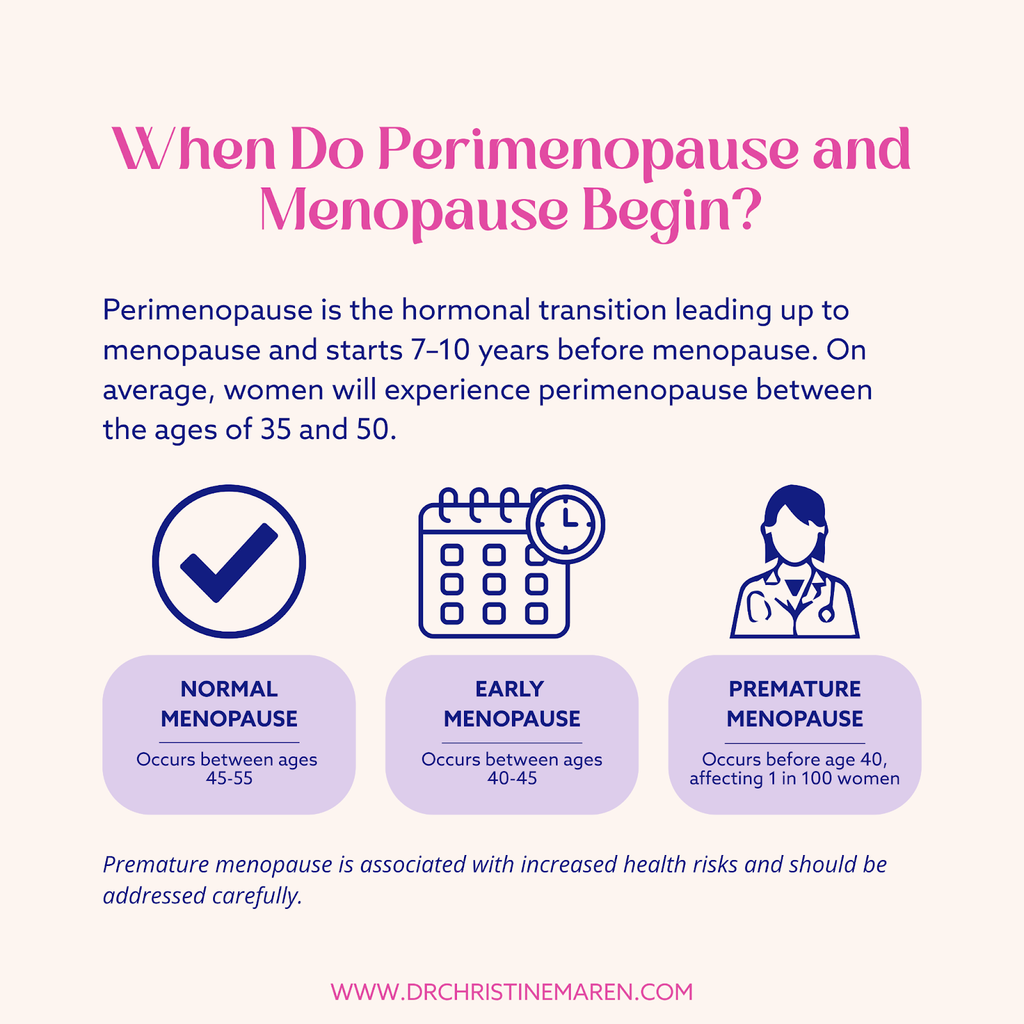
Some women experience menopause much sooner than expected.
Reaching menopause between 40 and 45 is called early menopause, and occurs in about 10% of women.1
Reaching menopause before age 40 is called premature menopause, premature ovarian failure, or premature ovarian insufficiency (POI) and affects about 1 in 100.2
Experiencing earlier menopause (early or premature) can increase your risk of certain conditions, including cardiovascular disease, low bone density (osteoporosis), loss of muscle, and cognitive decline.
Key Differences Between Perimenopause and Menopause
Perimenopause is the hormonal transition leading up to menopause. It is characterized by declining and sometimes chaotic fluctuations in hormone levels. Because hormones can be unpredictable during this phase, symptoms can feel inconsistent or nonspecific.
Menopause, by contrast, is the definitive state of hormone deficiency that is diagnosed after a woman has gone 12 consecutive months without a period (without other health conditions responsible for this). Menopause marks the end of the reproductive years and a sustained drop in estrogen and other ovarian hormones.
Perimenopause vs. Menopause Symptoms
So many of us struggle with health concerns in our 30s and 40s that affect our physical, mental, and emotional health. Yet we are often told this is a normal sign of aging: we need to eat less and work out more; we have anxiety; we should start birth control pills, etc.
Here’s the thing: perimenopause is often part of the problem, as shifting hormones create their own symptoms and also unmask underlying issues.
The tricky part? Symptoms don’t usually look like the classic “hot flashes” we’ve been taught to expect, especially when you’re early in the process. The more subtle symptoms are often dismissed or misdiagnosed.
That’s why I wrote a dedicated article: Early Perimenopause Symptoms: 10 Signs You Shouldn't Ignore in Your 30s and 40s
How to Tell Which Stage You’re In
One of the most confusing aspects of perimenopause is simply recognizing where you are in the transition. Symptoms can appear years before cycles become irregular, which is why many women do not realize they are in perimenopause.
If you’re not already, track your cycle length and flow, as this can provide important clues.
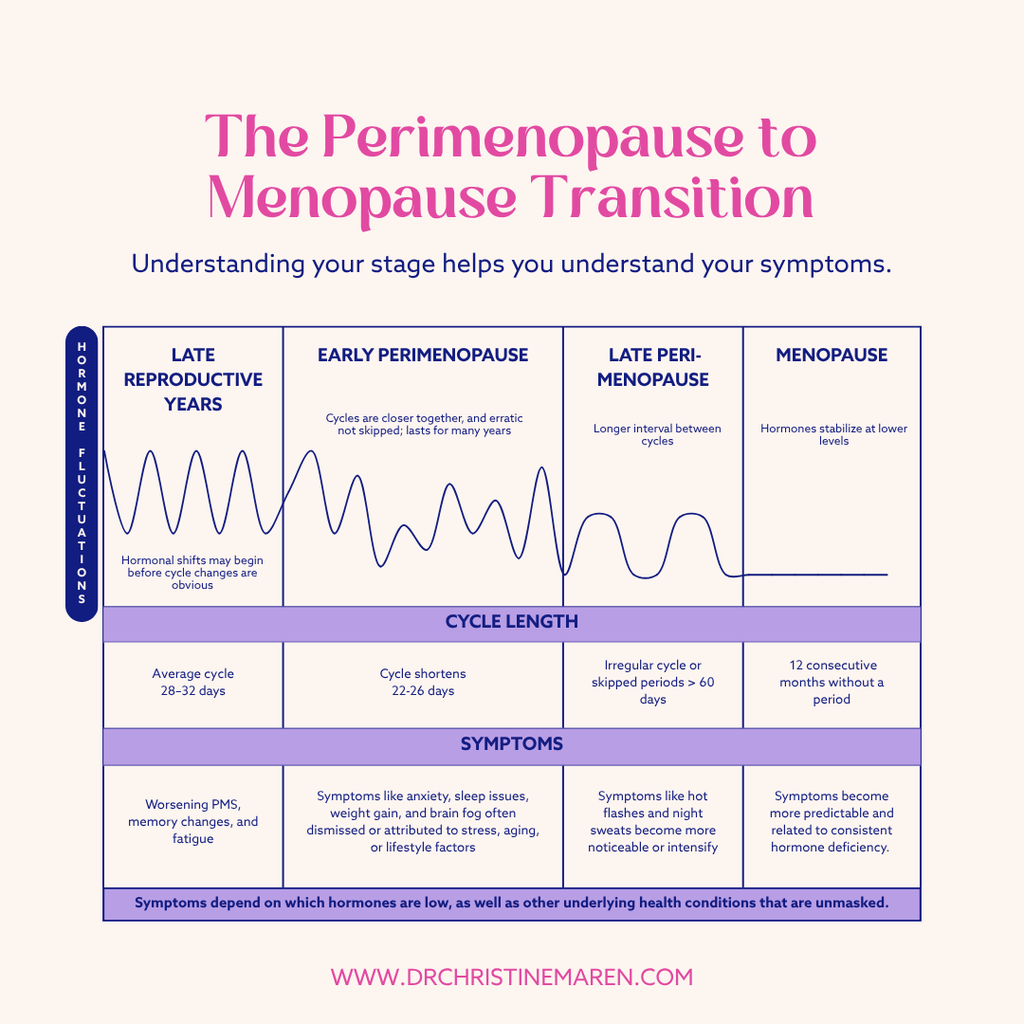
The STRAW (Stages of Reproductive Aging Workshop) staging system defines perimenopause and menopause based largely on changes in cycle length versus symptoms alone.
In my clinical experience, early perimenopause is the stage most often missed. Women’s cycles often become shorter (closer together), like every 22 to 26 days instead of 28 to 32 days. This can last for many years without being recognized.
As women move into late perimenopause, cycles often become more irregular with skipped periods and longer intervals between cycles, often more than 60 days. This phase is typically shorter than early perimenopause and is often accompanied by more noticeable or intensified symptoms.
Understanding your stage provides important context. It helps explain why certain symptoms are occurring, which tests are most useful, and when interventions such as progesterone, estradiol, or testosterone may be most appropriate.
Just as importantly, it helps women trust that real physiologic changes are taking place rather than dismissing their experience.
To Recap:
- Early signs of perimenopause (not to be confused with early menopause) last longer, and cycle length often gets shorter, but some women experience no change in their cycles
- Late symptoms of perimenopause often result in more irregular and skipped cycles
Hormonal Changes During Perimenopause vs. Menopause
As you’ve probably noticed, hormonal changes in midlife don’t exactly follow a linear pattern!
We attribute almost 40 different symptoms to perimenopause alone (although I would argue many of these symptoms are related to other underlying conditions).
In perimenopause, many women experience hormonal fluctuations, which can create unpredictable and inconsistent symptoms.
In menopause, as the hormonal chaos settles, women’s symptoms are often more predictable and related to consistent hormone deficiency.
Outside of changes in the menstrual cycle, some of the most common symptoms are neurological ones. But they are much broader than that. Common symptoms include:
- Anxiety
- Brain fog
- Word-finding difficulty
- Less mental stamina
- Irritability
- Sleep disruption
- Fatigue
- Low libido
- Weight gain
- Increased belly fat
- Thinning hair
- Bloating
- Inflammation
- Joint pain
- Hot flashes
- Night sweats
- Palpitations
- Urinary urgency
- Vaginal dryness
Symptoms depend on which hormones are low, as well as other underlying health conditions that are unmasked. I cover this in more depth in: Hormonal Changes in Perimenopause: How Estrogen, Progesterone & Testosterone Shift.
The Unmasking Effect–Why Symptoms Aren’t "Just Hormones”
Here’s one of the biggest lessons I’ve learned after treating thousands of women: Perimenopause unmasks underlying issues that have been brewing beneath the surface.
As hormone levels shift, our resilience shifts too, and the systems that were compensating start showing signs of strain.
This isn’t “just aging,” and it’s not “just perimenopause.” It’s the interplay between hormonal shifts and the rest of your physiology, which includes:
- Gut health
- Thyroid function
- Autoimmune disease
- Metabolism
- Micronutrient status
- Stress and trauma
This is why a whole-person, root-cause lens is essential. Treating symptoms without understanding the whole ecosystem means women don’t get the comprehensive help they need.
My intention is to help you understand both:
- How hormones shift in perimenopause, and
- Why these hormonal shifts can amplify underlying issues.
Because relief comes not just from managing hormones, but from supporting the systems that influence how those hormones work.
So, What About Treatment Options?
Perimenopause is not a diagnosis you rush past; it is a transition that asks to be understood.
When you recognize where you are in the process and why symptoms are showing up the way they are, everything changes. Instead of chasing isolated symptoms, you can begin supporting your body as an interconnected system.
Treatment is not one-size-fits-all, and it is not just about hormones alone. Thoughtful care includes foundational lifestyle strategies, targeted supplements, correcting nutrient deficiencies, addressing underlying health issues, and, in some cases, hormone therapy.
These tools work best when they are grounded in context, timing, and an understanding of the whole picture.
Hormone replacement therapy (HRT) in particular deserves nuance. It is neither something to fear nor something to prescribe as a one-size-fits-all.
In upcoming articles, I will walk through HRT in detail, including when it can be helpful, when caution is warranted, and how it fits into a comprehensive, evidence-based approach to midlife health.
How Our Practice Supports Women in Midlife
If you’re navigating this transition and want individualized guidance, our practice specializes in caring for women in midlife— addressing the intersection of hormones, thyroid function, gut health, metabolism, and autoimmune disease.
We take a whole-person, root-cause approach because your symptoms do not exist in isolation, and neither should your care. Click here to learn more about our approach to comprehensive care and how to become a patient.
If you are unsure whether your symptoms are related to perimenopause, start with My Hormone Clarity Quiz. It is a simple first step to understanding what your body may be signaling and how to move forward with greater confidence.
Perimenopause is not the beginning of the end of your life(!), and with the right support, it can be the beginning of deeper awareness, resilience, and long-term health.
References
- https://www.menopause.org/docs/default-source/professional/nams-2022-hormone-therapy-position-statement.pdf
- https://www.womenshealth.gov/menopause/early-or-premature-menopause
Also in this Series
- Perimenopause vs. Menopause: What's the Difference?
- What Factors Affect Age of Onset for Perimenopause?
- Is There a Blood Test for Perimenopause?
- Hormonal Changes in Perimenopause: How Estrogen, Progesterone & Testosterone Shift
- Early Perimenopause Symptoms: 10 Signs You Shouldn't Ignore in Your 30s and 40s