

A Functional Medicine Approach to Hashimoto’s Thyroiditis and Hypothyroidism
Published On: December 16, 2025

Hashimoto's is an autoimmune disease that, over time, destroys thyroid tissue and causes hypothyroidism. It is the most common cause of hypothyroidism in the U.S. and affects a surprising number of people (mostly women) worldwide. Some sources say it is 10 times more common among women than men, and most are diagnosed when they are between 30 to 50 years old.1
Despite how common it is, it’s still widely misunderstood and frequently dismissed in conventional settings. Millions of women struggle to even get a diagnosis despite their very real and concerning symptoms. Others get an accurate diagnosis, only to be told there is no solution for the autoimmune disease attacking the thyroid, other than a lifetime of medication.
I know how frustrating this is. As a woman who struggled with hypothyroidism and Hashimoto’s myself, I know what it’s like to watch your health go down the tubes while experts are telling you: “your labs look normal”, or “it must be stress!” and you know something is not right.
Fortunately, there’s a more comprehensive way to approach Hashimoto’s. When we evaluate autoimmune disease and thyroid health through a functional medicine lens, we can identify early warning signs, uncover what’s driving the immune response, and support the body so women feel better long before the disease progresses. That’s what this article is all about.
In this article:
- Why Hashimoto's is so Commonly Underdiagnosed
- Hashimoto's Symptoms in Women
- How to Diagnose Hashimoto's Disease
- Root Causes of Hashimoto's Disease (Genetics, Environment, Gut Health)
- Hormones and Autoimmune Disease (The Microgenderome)
- Treating Hashimoto's Disease with Functional Medicine
- Interested in Learning More About Hashimoto's?
Why Hashimoto’s is so Commonly Underdiagnosed
Autoimmune diseases, like Hashimoto’s, are underdiagnosed for a few reasons.
#1: Basic lab work doesn’t test for autoimmune conditions like Hashimoto’s. Standard lab panels may include TSH, and sometimes free T4. But to identify autoimmune thyroid disease, a clinician must order thyroid peroxidase antibodies (TPO) and thyroglobulin antibodies (TG). Many clinicians don’t order these unless your TSH is already in an abnormal range. Yet the immune system problem (Hashimoto’s) almost always precedes the thyroid hormone deficiency problem (hypothyroidism).
#2: Symptoms of Hashimoto’s are nonspecific. Fatigue, hair loss, anxiety, weight gain, constipation, brain fog, irregular periods, and cold intolerance are classic symptoms of Hashimoto’s…but they’re also common in perimenopause, chronic stress, anemia, gut issues, and micronutrient deficiencies. This is especially true in perimenopause, when many women assume their symptoms are “just hormones” when in reality, shifting hormones can unmask an underlying thyroid or autoimmune issue.
#3. Many clinicians assume testing won’t change treatment. A common belief in conventional medicine is: If I can’t treat it differently, why test for it? And since there is no drug that treats the autoimmune process in Hashimoto’s, many clinicians don’t see value in diagnosing it. A lack of tools in the conventional toolbox does not mean there is not another solution. The problem is that this misses the whole root-cause picture, which this article will address.
Hashimoto’s Symptoms in Women
Once again, Hashimoto’s is a problem with the immune system. Over time the autoimmune destruction of the thyroid gland can also create a problem with low thyroid function.
Thus, some patients may experience many of these symptoms while others experience only one or two. Much of this depends on how well you take care of your health and where you are in the disease progression.
Women with Hashimoto’s can experience a wide range of symptoms which might include:
- Fatigue or feeling like you can’t get enough sleep
- Brain fog or trouble concentrating
- Low motivation or feeling “slowed down”
- Anxiety, depression, or irritability
- Hair thinning or hair loss
- Bloating, constipation, IBS or other digestive issues
- Irregular periods or other hormonal symptoms
- Low libido
- Infertility or recurrent miscarriage
- Joint pain or body aches
- Dry skin
- Weight gain or difficulty losing weight
- High cholesterol or blood sugar
- Cold intolerance
This is by no means an exhaustive list, but it gives a good overview of how vast (and confusing) the symptoms can be.
Note: many of these symptoms overlap with perimenopause, and changes in sex hormones often reveal underlying thyroid dysfunction. You can read more about the thyroid–perimenopause overlap in my article, Thyroid vs. Perimenopause? A Guide to Signs, Symptoms, & Solutions.
Because these symptoms are so variable, proper Hashimoto’s testing becomes essential.
How to Diagnose Hashimoto's Disease
If your doctor suspects a thyroid problem, they will likely order a TSH test (Thyroid Stimulating Hormone). Sometimes they also order a free T4, but often this is only run if TSH is outside of the normal reference range.
The problem? This limited approach misses a lot.
TSH alone cannot diagnose autoimmune thyroid disease, nor does it reflect how well thyroid hormone is being produced, converted, or used inside the body.
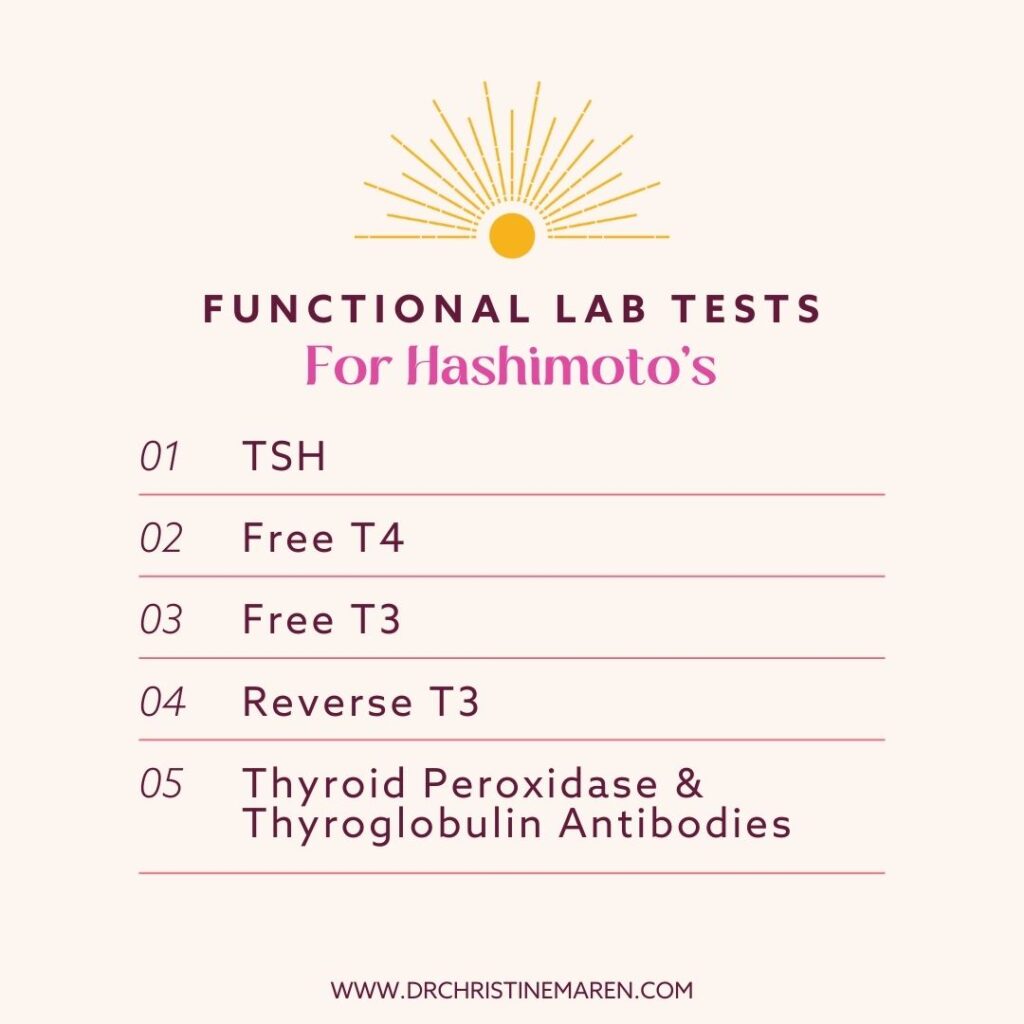
To accurately diagnose Hashimoto’s, you need both thyroid antibody testing and a complete thyroid panel.
The Essential Tests for Diagnosing Hashimoto’s
- Thyroid antibody testing (to identify autoimmunity):
- Thyroid peroxidase antibodies (TPO)
- Thyroglobulin antibodies (TG)
- Thyroid function testing (to understand hormone production and conversion):
- TSH
- Free T4
- Free T3
- Reverse T3 (if possible)
For women with hypothyroidism in pregnancy, I order total T4 and total T3 instead.
I also consider a thyroid ultrasound if there are concerns about nodules, structural changes, or long-standing autoimmune thyroiditis. This is also helpful if there’s a strong suspicion of autoimmune thyroiditis despite normal antibodies (up to 10% of patients can present this way). Ultrasound is not a primary diagnostic tool for Hashimoto’s, but it can provide helpful information.
Why TSH Alone Misses So Many Cases
There are significant limitations with checking a TSH alone to screen for thyroid dysfunction. 2
- Most U.S. labs use an upper limit of 4.5–5.0 mIU/L, even though research shows that 95% of healthy individuals have a TSH below 2.5 mIU/L. 3
- Several studies, including published research in the Journal of Clinical Endocrinology & Metabolism, recommend lowering the upper limit to 2.5 mIU/L. 4 5
- Women may have a TSH in the “normal” range but elevated antibodies, impaired free T3 conversion, or clear symptoms. This means many women with early Hashimoto’s fall into a “gray zone” where their TSH looks normal, but their immune system is already attacking the thyroid.
Personalized Interpretation Matters
A population-based reference range may not reflect what’s ideal for an individual. Some women simply don’t feel well with a TSH of 4, even though it falls within the normal reference range.
We already acknowledge this during fertility evaluations. The standard of care is that women trying to conceive should have a TSH below 2.5 mIU/L (however this isn’t always recognized in general practice). Read more in: Thyroid, Fertility, and Pregnancy: An Integrative Functional Approach.
A complete, individualized approach to thyroid testing is important, especially for women who feel symptomatic but continue to be told their labs are normal.
For the complete list of thyroid labs I run in my practice, as well as the optimal ranges where women feel best, download my comprehensive guide to thyroid lab testing.
This guide walks you through:
- The full thyroid panel I use for diagnosing Hashimoto’s and understanding thyroid function
- What each marker means
- Optimal vs. lab reference ranges
- How to talk with your doctor about testing
Root Causes of Hashimoto’s Disease (Genetics, Environment, Gut Health)
Once we’ve identified Hashimoto’s, the next step is understanding why the immune system targeted the thyroid in the first place. That’s where root-cause work becomes essential.
Remember, your body loves you, it is not against you. It is responding to something and trying to protect you.
A framework for understanding the root causes of autoimmune disease comes from Alessio Fasano, MD, whose research identifies three core drivers of autoimmune disease:
#1: Genetics
#2: Environment
#3: Gut Health
Let’s look at these factors individually and in relation to the whole.
Genetics: It’s long been recognized that genetics play a role in autoimmune conditions, including Hashimoto's. However, not every person with a genetic predisposition will develop an autoimmune condition. There’s a saying in epigenetics (the field of medicine that studies genetic expression): “Genes load the gun, environment pulls the trigger.” This explains, to some extent, why two people can have the same genetic predisposition toward a disease, yet only one winds up getting sick.
Environment: Environmental triggers are different for everyone. These may include heavy metals from a dental procedure or certain foods, pesticides from your lawn care service, a food sensitivity to gluten, dairy, or corn which has weakened your gut lining over time, radiation exposure, chronic stress, mold, or many other triggers. Like genetics, environment has been shown to contribute to Hashimoto’s.
Gut Health: Dr. Fasano’s work highlights intestinal permeability as a necessary component of autoimmune disease. When the gut barrier becomes compromised, the immune system loses tolerance and becomes dysregulated. Zonulin (a protein that regulates tight junctions) increases in response to certain triggers and contributes to this process. 67
Read more in: The Functional Medicine Solution for Autoimmune Disease.
Hormones and Autoimmune Diseases (The Microgenderome)
What Dr. Fasano’s triad doesn’t explicitly highlight is that hormones play an important role in the development of autoimmune disease.
Many women experience their first autoimmune flare during a hormonal transition like postpartum, perimenopause and menopause.
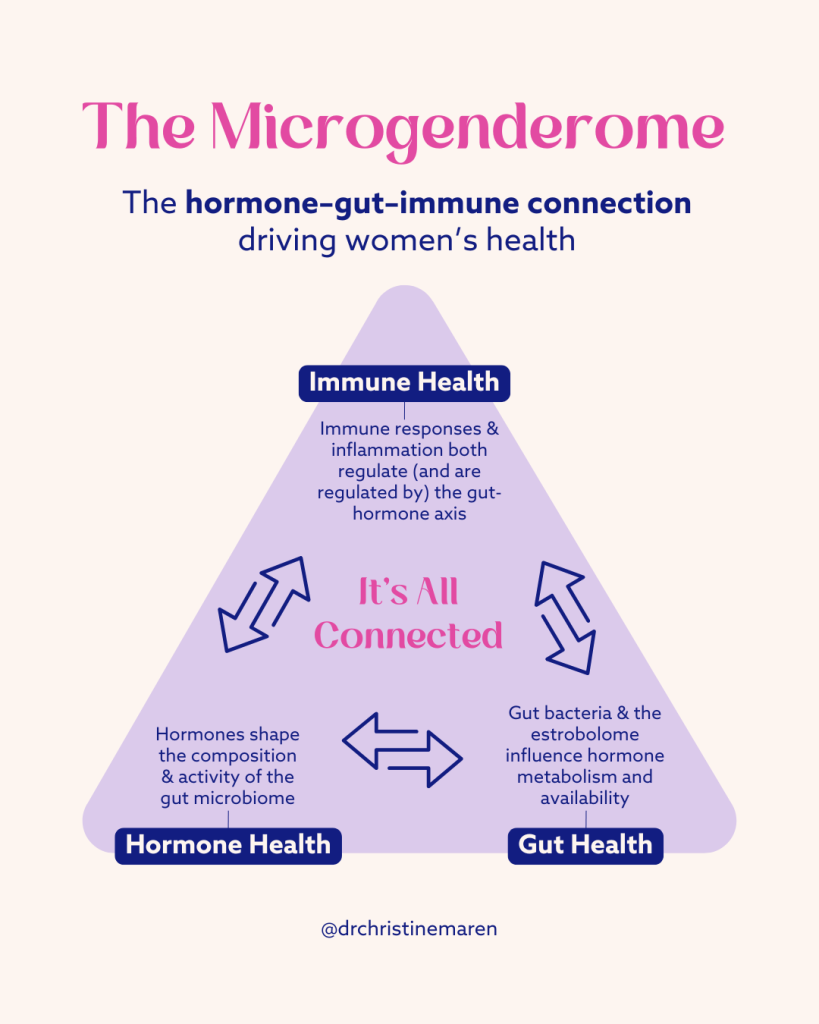
This is where an emerging field of research becomes important. The microgenderome explains the bidirectional relationship between sex hormones, the gut microbiome, and the immune system, which helps account for why women are disproportionately affected by Hashimoto’s. 8
This helps explain why:
- Women are far more likely to develop autoimmune diseases than men.
- Sex hormones influence both innate and adaptive immunity.
- Changes in sex hormones directly alters the gut microbiome.
- The composition of the gut microbiome influences hormone levels.
- Thyroid function is tightly linked to gut health and sex hormones.
In other words: Hormones influence the gut, the gut influences hormones, and both influence the immune system. This is the microgenderome.
This triad is a primary focus in my clinical work because it explains why so many women feel their symptoms “flare” during hormonal transitions—and why addressing hormones often plays a critical role in putting autoimmune disease into remission.
Treating Hashimoto’s Disease with Functional Medicine
To successfully treat Hashimoto’s and decrease thyroid antibodies over time (yes, we can measure that!), we take a comprehensive and individualized approach.
Our framework is built on three essential pillars: Addressing Root Causes, Optimizing Hormones, and Building Resilience.
With Hashimoto’s, a common root cause issue is underlying gut infections like small intestine bacterial overgrowth (SIBO), fungal/ candida overgrowth, parasites etc. There’s almost always another layer to address which often includes food sensitivities, nutritional deficiencies, environmental toxins, and/or trauma.
Optimizing hormones is also an important aspect of treatment, especially for women with hypothyroidism and/or other hormonal concerns like perimenopause. This often includes prescription medications aimed at carefully and precisely replacing thyroid and/or sex hormones like estradiol, progesterone and testosterone.
The benefit of working with a physician-led team who practices both functional medicine and menopause medicine is that we can help you manage hormones (if necessary) in conjunction with other integrative modalities like supplements and gut health.
To recap:
- Hashimoto’s is an autoimmune disease.
- Over time, it can cause hypothyroidism.
- Unfortunately, it is not usually diagnosed early because it cannot be detected through basic lab work (such as TSH).
- Hashimoto’s is caused by a combination of genetics, environmental triggers, and gut health; though everyone’s triggers will be different.
- Hormones also play a critical role in autoimmune disease.
- Functional Medicine has an excellent track-record in helping people diagnose, treat, and overcome Hashimoto’s.
- Advanced lab work, and other testing is the only way to identify the real cause of and solutions for individual cases.
- Keep educating yourself so that you can effectively advocate for yourself!
Interested in Learning More About Hashimoto’s?
Thyroid health is deeply individual, and you don’t have to navigate it alone. Whether you’re newly exploring symptoms or actively managing Hashimoto’s, my team and I are here to help you get clear answers, understand your labs, and create a path toward feeling like yourself again.
If you’re ready for personalized support, you can learn more about working one-on-one with my team. We take a root-cause, hormone-informed, whole-body approach to thyroid health, and we’d love to be part of your care team.
If you want to stay connected, join my monthly newsletter. You’ll receive new articles, hormone and gut health insights, evidence-based strategies, and practical tools to help you make confident decisions about your health.
And if you haven’t downloaded it yet, grab my Thyroid Lab Guide. It is the most comprehensive, easy-to-understand resource I’ve created for women who want to interpret their thyroid labs accurately and advocate for themselves with confidence.
No matter where you are on your journey, you’re in the right place. Remember: trust yourself and your intuition if something doesn’t feel right. You don’t have to settle or figure this out on your own.
References
- https://www.ncbi.nlm.nih.gov/books/NBK459262/
- https://www.ncbi.nlm.nih.gov/pmc/articles/PMC3529417/
- https://www.ncbi.nlm.nih.gov/pmc/articles/PMC5957513/
- https://www.ncbi.nlm.nih.gov/pmc/articles/PMC5957513/
- https://academic.oup.com/jcem/article/98/9/3584/2833082
- https://pubmed.ncbi.nlm.nih.gov/21248165/
- https://pubmed.ncbi.nlm.nih.gov/22731712/
- https://pubmed.ncbi.nlm.nih.gov/30298433/