

How to Lose Weight in Your 40s (and beyond)
Published On: June 10, 2024
In my 40s I found myself carrying an extra 5-10 lbs of stubborn weight. All the normal tricks and it didn’t budge. Perhaps you can relate.
Was I overweight? No.
Was I comfortable in my clothes? Also no. And damn it, those jeans were expensive.
This article, which is a first of its kind for me (and I’ll explain more about why coming up), shares how I lost weight in my 40s without depriving myself and instead focusing on nourishing my body, mind, and spirit.
I’ve since been applying this approach to help my patients who are in a similar situation, some with just a few stubborn pounds to lose, and others with more lofty weight-loss goals.
My hope is that this will inspire you to rethink trendy, often short-term, and potentially damaging weight-loss programs and focus first on a lifestyle that nourishes and builds strength, health, and resilience as you lose weight.
It's not a quick fix - but I do have some tricks up my sleeve for midlife weight management.
In the first half of this article, we’ll focus on crucial mindset and lifestyle changes that form the foundation of lasting weight management. These cornerstones not only support weight loss but also improve overall well-being.
Then we'll explore advanced options like hormone replacement therapy and GLP-1 medications, which can offer additional support when lifestyle changes alone aren't enough.
Remember, the journey to a healthier you is personal and multifaceted, often requiring a combination of approaches tailored to your unique needs.
Sound good? Let’s get started.

If this resonates, there's more.
My newsletter and community are where I share clinical insight, evolving research, and what's helping women feel more like themselves again in midlife.
5 Reasons I Haven’t Talked about Weight Loss Before
Although achieving and maintaining a healthy weight (which can vary for every person based on numerous factors) is essential for good health, I’ve shied away from talking to you about weight loss for the following reasons:
- Often when we address underlying health issues and inflammation, weight comes off naturally.
- I want you to know you are beautiful and capable at any size, and the standards that society sets for women are unreasonable and often, unachievable, especially after having children or when dealing with chronic stress or disease.
- So many women have disordered eating and body image issues already, and I don’t want to contribute to that.
- What we see in magazines isn’t real, it’s photoshopped. Again, I’m not interested in pushing these ridiculous standards on women (or men for that matter!) one bit.
- What we look like shouldn’t define us as women. This false story of successful womanhood has plagued and crippled too many of us, and, in my opinion, it must not go on.
In other words, there is an argument for buying new jeans. And there’s no shame in that, so banish those thoughts now.
So, why am I addressing this now (besides to share my own struggle and success story?)?
Because I get it. I hear about weight concerns from other women over and over, and I can relate. I also want to look my best and radiate confidence.
Plus, we know that excess weight contributes to metabolic dysfunction and increased risk of all the diseases we don’t want. And excessive belly fat is an indicator of deep visceral fat (fat that surrounds the internal organs) and that’s especially dangerous for long term health.
Ultimately my mission is to help other women be happier, healthier, and age well from preconception through menopause—and that includes weight loss when it’s a healthy goal.
So here we go!
In this article, we’ll bust some myths about losing weight, address the hormone piece (yes, that’s definitely a thing), and tell you what you should actually be doing to get your metabolism going again to achieve a healthy weight for your body type, age, and goals.
Stop Obsessing Over Diet and Start with Mindset First
As women, we often drive ourselves crazy obsessing over calories, carbs, sugar, fats, vegetables, macros, and everything in between.
Yet, the little-known truth is that mindset is the #1 tool for mastering new habits. Which is why we start with mindset first.
The good news is creating healthier habits (versus trying to break bad habits) is pretty simple: “Repeat a chosen behavior in the same context, until it becomes automatic and effortless.”1
In a British publication titled “Making Health Habitual: The Psychology Of ‘habit-Formation’ And General Practice” we learned that forming one ‘small’ healthy habit can help increase self-confidence for working towards other health-promoting habits.2
This can have a cascade effect as you increase your belief that you can accomplish your goals and learn to trust yourself.
The big takeaway: Starting with ‘small’ and achievable goals is more likely to lead to long-term success.
That said, creating healthier habits can take some time, with research suggesting new habits become automatic after about 66 days.3
Give yourself loving grace, and take it one week at a time. And if you slip? No shame. “Correct and continue.” is what my coach always says.
What I’ve learned about myself in this process is that I was really enslaved to being low-maintenance.
Somehow, I subconsciously expected myself to look amazing without actually working for it.
I imagine many moms in their 40s can relate to this, especially if they’ve grown up being the “easy child” or the “cool girl.” This type of childhood conditioning reinforces the belief that we should be low maintenance and not have needs.
Now that I have revealed that subconscious thought, I can acknowledge it and let it go. I’m ready to work hard and make some sacrifices for what I want.
If this resonates with you, I invite you to examine your self-perceptions or beliefs about yourself to better understand what you can capitalize on and what might be holding you back.
Here’s a major caveat, as mentioned previously I see so many women with disordered eating.
This exercise is not meant to reinforce restrictive or manipulative or shaming behavior.
If you’re struggling with that, stop here and read our article: 7 Tips + Resources to Cultivate a Healing (Growth) Mindset Right Now.
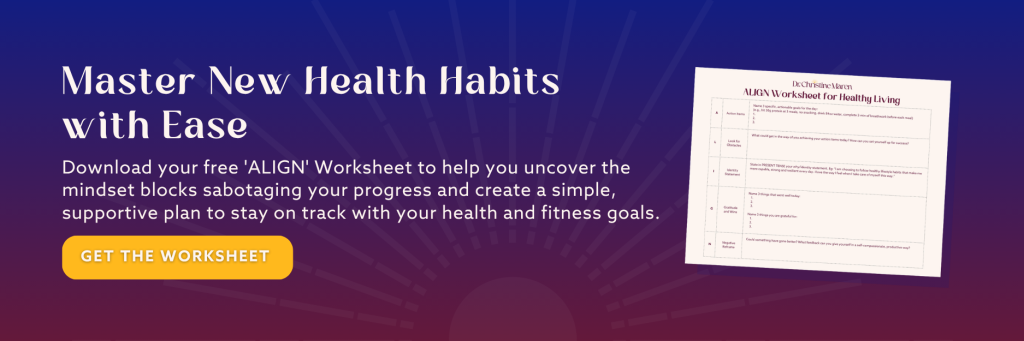
Consider using our “ALIGN” worksheet to help you stay positive and track your progress – click below to download the free PDF:
Find the Why Behind Your Desire to Get Fit and/or Lose Weight
Now that you know habits are essential to life-changing progress, the big question becomes how we stay committed to our habits to achieve our goals.
It all begins with YOUR WHY.
Whether it's pursuing a career change, starting a new business, or committing to a healthier lifestyle, a strong "why" serves as the fuel that propels us forward, even when faced with challenges.
So what’s yours? Why do you want to lose weight and be more metabolically healthy?
It’s vital to write your why down very clearly, whatever that may be.
This step cannot be skipped, so take at least 15-20 minutes and get granular with it.
Here are some prompts and questions to help you get started and gain clarity:
- Picture yourself at your goal weight, with strong muscles and a robust, healthy metabolism.
- How does it feel?
- What activities are you doing every day?
- What are you capable of doing in this body that you aren’t capable of doing right now?
- What do your relationships feel like?
- What stresses do you have?
- What stresses are no longer present?
Funny enough, the thing that brought me back to strength training as a tool for weight-loss, after so many years away, was my neck.
I discovered a herniated disc in my cervical spine after getting a full-body MRI with Prenuvo.
This caused over a decade of undiagnosed debilitating headaches. And after a lot of Physical Therapy, I knew I had to get stronger in order to support my axial skeleton and neck.
I also love to play hard—whether that’s skiing, wakeboarding, hiking or hip-hop—and I don’t want any physical condition to hold me back from that or from doing fun things with my family. Plus, my husband is an animal, and I intend to keep up with him!
I am personally motivated to be the best version of myself–the healthiest, fittest, smartest, and most confident I can be.
This isn’t about perfection, it’s about striving for excellence. It’s part of what drew me to functional medicine and a characteristic I see in many of my patients.
So take a minute and write it down—why do YOU want to do this for yourself?
Why is it Hard to Lose Weight After 40?
Losing weight as a 40-something is very different than it was as a 20- or even 30-something.
Getting on the treadmill and doing cardio isn’t going to get us very far, and depriving ourselves of food isn’t going to work, either (for more reasons than one).
This is largely due to a distinct shift in hormones that happens in our late 30s or early 40s, which plays a role in our metabolism.
It’s called perimenopause and it starts around age 35-45 for most women (yep, that’s what you’re experiencing with the wacky hormone symptoms at this age).
Perimenopause is the time when we start to experience a decline in estrogen (all these symptoms will be discussed in this article) before we hit full-blown menopause.
During perimenopause/ menopause, a decrease in estrogen levels can lead to several metabolic changes that may contribute to weight gain.
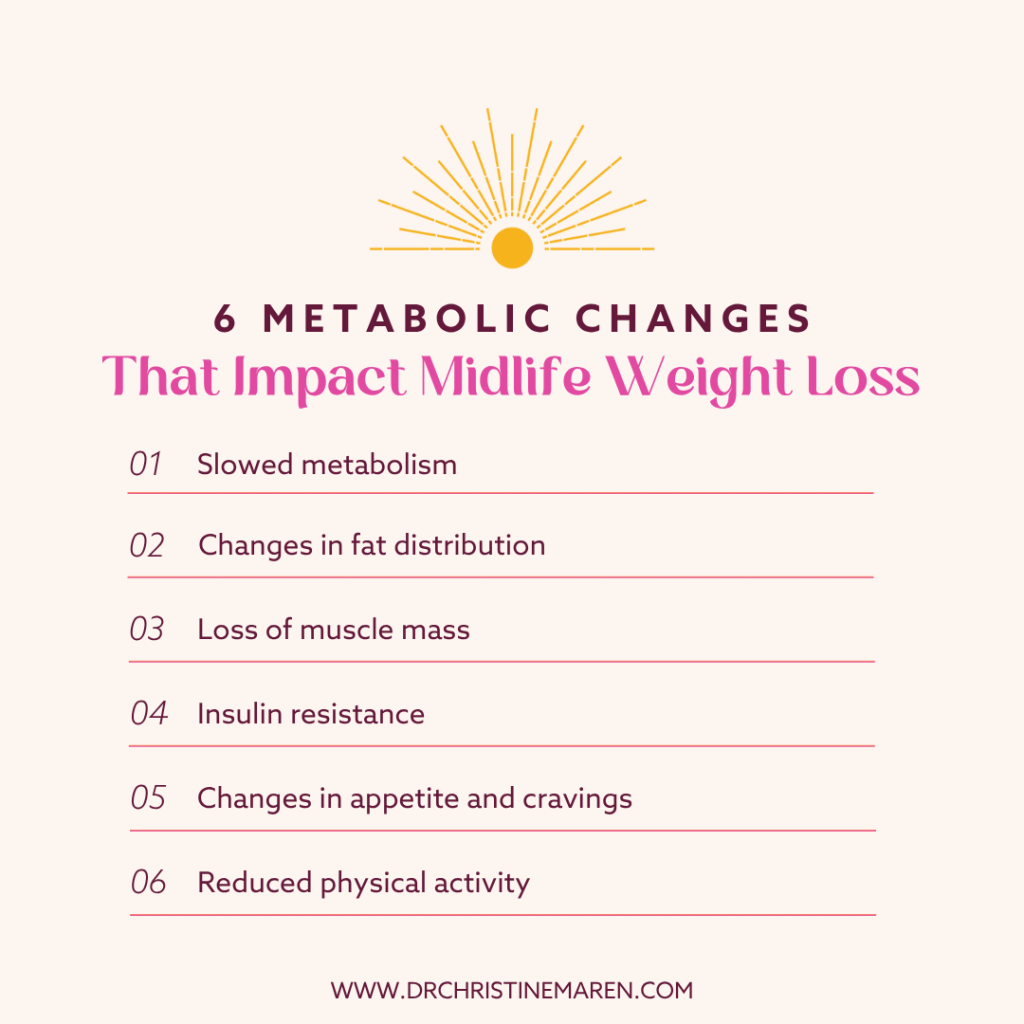
6 Metabolic Changes that Happen in Your 30s and 40s That May Affect Weight
- Slowed metabolism: Estrogen helps regulate metabolism, and its decline during perimenopause/ menopause can lead to a decrease in metabolic rate and blood sugar balance. This means the body may burn fewer calories at rest, making it easier to gain weight.4, 5, 6
- Changes in fat distribution: Women may experience a shift in fat distribution, with more fat accumulation around the abdomen rather than the hips and thighs. This visceral fat, which surrounds internal organs, is associated with an increased risk of metabolic disorders and cardiovascular disease.7
- Loss of muscle mass: Aging and hormonal deficiencies can contribute to a loss of muscle mass, known as sarcopenia. Since muscle tissue burns more calories at rest than fat tissue, a decrease in muscle mass can further decrease metabolic rate and make it harder to maintain or lose weight.8
- Insulin resistance: Decreased hormone levels, like estrogen, can also lead to insulin resistance, where cells become less responsive to insulin. Insulin resistance can promote weight gain and increase the risk of type 2 diabetes.9
- Changes in appetite and cravings: Hormonal fluctuations can affect appetite regulation and lead to increased cravings for high-calorie, sugary foods. This can contribute to overeating and weight gain.10
- Reduced physical activity: Some women may experience decreased energy levels or motivation to exercise during perimenopause/menopause due to other symptoms and/or the demands of life/motherhood. This can lead to a decrease in physical activity levels and contribute to weight gain.
On top of that, there are other conditions like hypothyroidism that can affect metabolism in a big way. Hypothyroidism, either undiagnosed or untreated, is something you’ll want to address.
I regularly check a full thyroid panel on my patients and support thyroid hormone replacement when necessary.
Learn more in: A Functional Medicine Approach to Hashimoto’s Thyroiditis and Hypothyroidism.
Stress is also a significant player in your ability to lose weight after 40
The stress hormone cortisol, for example, can be very antagonistic to weight loss and weight management.
High levels of cortisol driven by excessive stress can increase appetite and cravings, especially for high-calorie foods that are rich in sugar and fat.
Elevated cortisol also promotes fat storage (particularly abdominal fat), stimulates glucose production, reduces the sensitivity of cells to insulin, breaks down muscle tissue, and disrupts sleep.11
Now you know why many of us gain a mysterious 5-10 pounds, or more, without explanation.
What Is The Secret To Losing Weight After 40?
Here’s the deal: the “secret” to losing weight after 40 is to focus on body recomposition (gaining more muscle and losing fat) vs. just losing weight.
We also want to address those issues previously discussed related to perimenopause/menopause, hypothyroidism and high cortisol – we’ll get to that next!
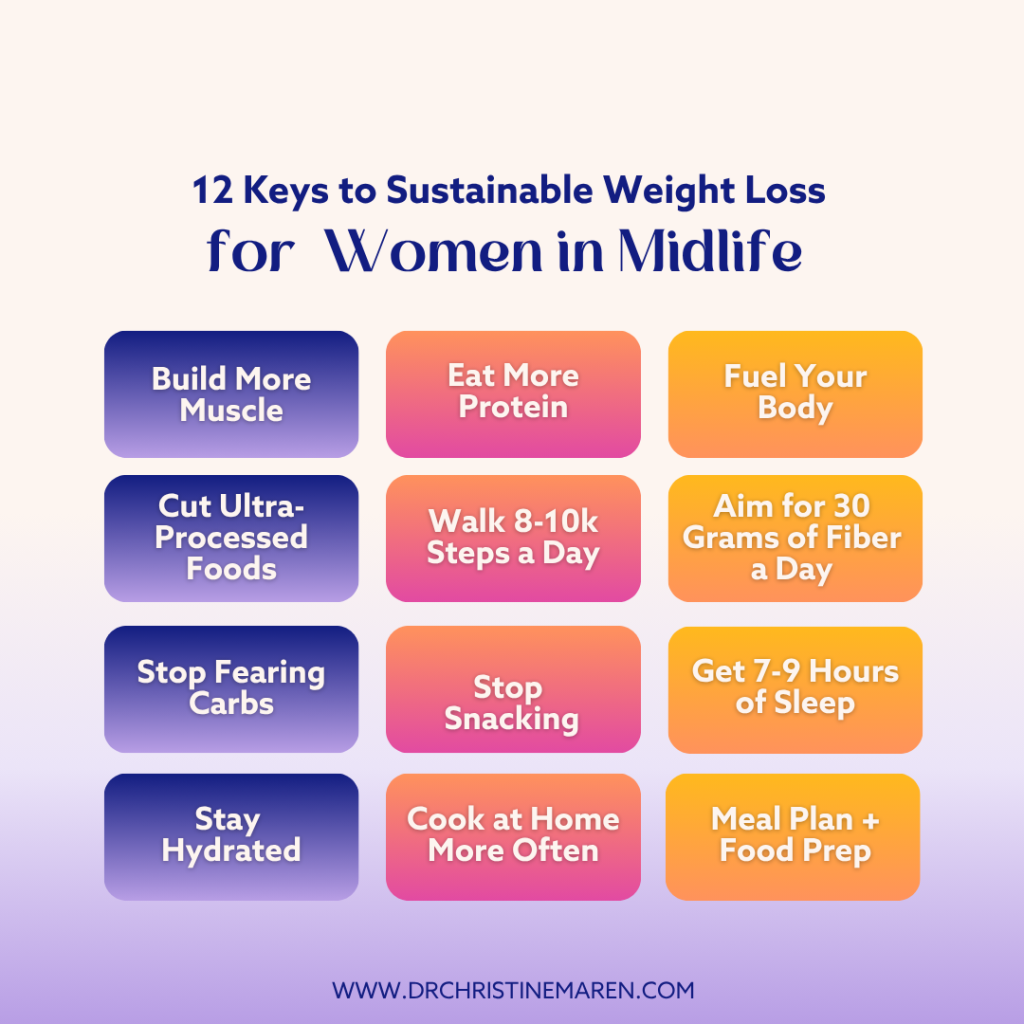
So, without further ado here are 12 keys to achieving sustainable weight loss in midlife (the first three are the most important!)
1. Build more muscle
Let me say that again…you need MORE muscle!
This is a great place to start because muscle boosts metabolism. Muscle is expensive tissue that plays a major role in creating and protecting a robust metabolism.
How do you do this? By lifting weights and/or using bodyweight exercises several times per week.
My coach recommends 4-5 heavy-weight training sessions weekly.
I stick with a specific program for 6-8 weeks using “progressive overload”, which means either increasing weight or reps every week. Then I start again with a new progressive cycle of different exercises.
While you burn fewer calories in a single weight training session than in an hour of high-intensity cardio, you’ll build muscle, which makes your body that much more efficient at using calories and regulating blood sugar 24 hours per day.
The net payoff means better body composition that’s easier to maintain over time—and I’m all about whatever is sustainable.
Research also suggests gaining more muscle helps protect bone density and even build bone, which is an important consideration as we get older.12, 13, 14
2. Eat more protein
Protein gives your body the building blocks (amino acids) you need to build bigger muscles.
Protein is also the most satiating of the three major macronutrients (protein, fat, and carbohydrates), helping you feel fuller longer.
If you’re trying to build muscle (i.e. actively weight training), aim for 1 gram of protein per pound of target body weight.
Protein is also thermogenic, meaning it costs about 20-25% of the energy within the food to digest and assimilate dietary protein.
Pro tip: eat the protein portion of your meal FIRST to ensure you get enough. This also helps regulate blood sugar.
For more information, read our article: How Protein Optimizes Healing & How to Find the Best Sources.
3. Fuel your body
Our bodies are smart and adapt to a low-calorie diet.
Chronic calorie restriction creates an adaptive response that allows us to survive with fewer calories.
This is why calorie restriction doesn’t work for everyone, or why someone who eats very few calories can still be overweight. It’s all about adaptation and survival.
Instead, we want to signal abundance to our bodies so we know it is safe to burn fuel (aka that stubborn body fat!).
This means eating hearty meals with the right amounts of protein and other nutrients at mealtimes (which we’ll discuss more in the coming weeks).
The majority of women I work with in their 40s or 50s are on a calorie-restricted diet in an effort to lose weight, or they’re just not eating enough because life is busy and they’re not prioritizing their own nutrition.
Instead, teach your body to USE fuel by providing it fuel (especially to fuel those weight training sessions we talked about earlier).
More on this in subsequent sections.
4. Cut out ultra-processed foods
Ultra-processed foods aren’t just empty calories that take up space, they also hijack your hormones and send mixed signals to your brain.
Plus, because they are so different from whole foods, your body can’t utilize them in the same way.
In fact, these franken-foods are often designed to increase cravings! And people who eat them tend to overeat by up to 500 calories per day.15
So, for optimal metabolism, the golden rule is to reduce “boxes, bags, and barcodes” and instead focus on foods in their “whole form” which will provide nutrients within a food matrix your body recognizes.
When your body gets energy (calories) from the food it recognizes, it knows what to do.
Nutrient needs get met, hormones align, satiety is more easily achieved, and optimal body weight/composition is more easily maintained.
Get more helpful tips in: Tips to Stop Sugar Cravings + A Guide to Healthy Sweeteners.
5. Walk 8-10k steps per day
We were meant to move slowly and often throughout the day. Yet, many of us—even if we get an exercise session in—are way too sedentary.
Walking is one of the best, low-impact ways to move.
It’s an easy way to improve digestion after meals and helps us burn more body fat without increasing hunger, and being outside in nature creates additional benefits.
For some people, it makes sense to use a walking pad or desk treadmill—whatever you need to do to get those steps in!
Pro tip: walk with a weighted vest like this one (I have the 12lb version).
6. Aim for 30 grams of fiber a day
This is important for your gut health and can also help maintain satiety.
Lean into foods that are naturally rich in fiber, such as non-starchy veggies, fresh whole fruits, chia seeds, and flax seeds.
Note that although all vegetables are great for overall health, certain vegetable fibers, like broccoli and cauliflower, can worsen bloating for some people.
If you struggle with this, be aware it and opt for more easy-to-digest veggies like cucumbers, bell peppers, carrots, celery, asparagus, green beans, etc.
If this resonates, there's more.
My newsletter and community are where I share clinical insight, evolving research, and what's helping women feel more like themselves again in midlife.
7. Don’t be afraid of carbs
When I started this journey, I was inadvertently eating high-fat, moderate protein, and low carbs.
Now, I am eating much higher carbs and protein. Although I am by no means low-fat, I am choosing leaner meats and enjoy more moderate amounts of avocado, nuts, seeds, and olive oil.
We do have to be smart about carbs because they impact blood sugar and insulin levels the most of all the macronutrients.
And chronically high blood sugar and insulin make losing body fat really hard because insulin tends to lock body fat away.
However, eating moderate amounts of healthy, fiber-rich carbs actually helps in the regulation of cortisol - your body’s master stress hormone that affects stress response, metabolism, endocrine health, and immune function!
Here are some other weight-loss benefits of eating healthy carbs from vegetables, fruits, legumes, and whole (preferably gluten-free) grains:
- Carbs can enhance the production of serotonin, a precursor to melatonin, your body’s master sleep hormone. And when we sleep well, it’s much easier to lose and maintain a healthy weight.16
- Carbs support adrenal function via their effects on cortisol, which can positively impact all hormonal functions, including those that impact your weight.17
- Nutrient-dense carbohydrates provide essential nutrients, such as B vitamins, fiber, prebiotics, antioxidants, and magnesium, which are crucial for adrenal function and stress management.
- Eating carbs from fruits and vegetables can reduce feelings of perceived stress.18 Yes, protein is paramount for satiety and muscle building, however, a lack of carbs (or any major food group) can send a stress or survival signal to the body to hang onto weight, glucose, etc. Eating moderate amounts of carbs can help ease feelings of perceived stress, thereby balancing cortisol, adrenaline, and other stress hormones.
Plus, for some of us, a low-carb diet during perimenopause/ menopause may exacerbate certain symptoms.
Carbohydrates are crucial in providing energy, fiber, and supporting hormone balance, which is particularly important during this transitional phase of life.
And if you are lifting heavy weights—and you NEED to be lifting heavy weights, friends—some good carbs will do you good because your body will quickly and efficiently use the blood sugar provided by those carbs to fuel your difficult workouts (woo hoo!).
This will equal stronger weight sessions and more muscle gain.
Remember, more muscle means a higher metabolic rate and better glucose control.
What about simple carbs? Yep, you can still have them, too.
It’s best to add them immediately after a weight training session. This is when your muscles can use simple carbs to restore glycogen, and you’ll recover quicker. I started eating some things I’d never thought I would eat on a “diet” like rice crispy treats made by my one and only 12-year-old baker.
And bonus: Even after your training sessions are over, your muscles continue to soak up blood sugar (replacing the glycogen that was broken down during workouts).
Pro tip: Many cooked and cooled starches (like leftover potatoes and rice) are a great source of resistant starch, which has many health benefits, including blood sugar regulation and gut health.
8. Stop snacking
I know lots of experts have recommended small frequent meals for weight loss over the past decades.
However, times are changing (yet, again), and I recommend aiming for 3 healthy and substantial meals rather than grazing all day.
This means no snacking, which was surprisingly difficult for me to do. I didn’t actually realize how much snacking was happening in my life!
Now, I am focused on eating three large meals a day, which keeps me satiated, so I don’t need to snack.
This is also important for gut health because refraining from eating between meals gives your gut (specifically the MMC, or Migrating Motor Complex) a chance to clean house, so to speak, between meals.
This is super important for anyone with IBS/SIBO or bloating.
9. Get 7-8 hours of good-quality sleep
If you don’t sleep enough (or sleep well enough) for even ONE night, you will create insulin resistance in your body the very next day—a state that makes fat loss really hard to achieve.
High insulin locks body fat away, which is a survival mechanism.
Lack of sleep also increases cravings for sugary, salty foods due to its effects on appetite-regulating hormones.19
Biochemistry is powerful, and there usually isn’t enough willpower to get past strong cravings.
So, get your zzzz’s, which means at least 8-10 hours per night for weight loss, or more if you can swing it.
10. Hydrate!
Did you know hunger signals can actually be a sign of dehydration?
To combat this, be sure to drink lots of clean filtered water between meals.
Ideally, start your morning with a big glass of filtered water (do this before coffee), and add lemon for additional liver/detox benefits.
Remember that publication I mentioned above called “Making Health Habitual?” Forming daily habits paired with a ‘small change’ (like drinking a glass of water every morning), has been shown to set off a cascade effect that will help change behaviors over a lifetime.20
Note: Although some weight-loss experts recommend drinking water with meals to improve satiety, I recommend the opposite! For optimal digestion, I limit water intake with meals since that can dilute stomach acid and digestive enzymes.
Fluids are best consumed in large quantities during a workout and between meals if possible.
11. Cook at home more often
Cooking at home will give you much more influence over what goes into your meals, especially the quality of oils used.
Most restaurants use inflammatory seed oils, so you’ll consume far more low-quality calories than you would at home.
While this doesn’t seem like a big deal, cooking at home more is such a powerful tip, so don’t ignore this one.
If you think this will put a damper on your social life, consider meeting friends for walks or getting together to play cards or pickleball instead of meeting for lunch or dinner out. Or save those dinners out for a special occasion rather than several times per week.
For more tips, read our article: Healthy Meal Prep: 8 Ways To Cook Your Way to Better Health (even if you’re busy!)
12. Plan your meals and food prep
Getting enough nutrients, especially protein, takes some effort.
Be intentional about meal planning and make sure your fridge is well-stocked. Otherwise fast, ultra-processed foods will be your easier choice.
At the beginning of each week, think about the meals you want to prepare and make sure you have the ingredients and time to cook them.
Then, start every morning putting some thought into what each of your 3 meals will be for the day.
This might take some effort at first, but will soon become an easy habit and is one of the best ways to set yourself up for success!
Pro tip: Get in the habit of cooking extra protein when you’re making dinners to use the leftovers for over some leafy greens at lunch the next day.
Get more tips and tools for meal prep in: Healthy Meal Prep: 8 Ways To Cook Your Way to Better Health (even if you’re busy!)
Bonus Tip: Track your macros
Tracking my meals was something I was a little apprehensive about, and it’s not for everyone, long-term.
I didn’t want to obsess over food (and I don’t want you to, either), but tracking meals can help you achieve results faster.
Tracking my macros for a few months has taught me a lot about how much protein I’ll get in a chicken breast versus ground beef, and how many carbs I’ll get in a baked potato versus a cup of pasta.
I use MyFitnessPal for this and Chronometer is great, too.
Note: if you have a history of disordered eating, it’s probably best to avoid this and just focus on getting enough protein.
Hormone Therapy and Low Dose GLP-1s: Advanced Solutions for Midlife Weight Management
Hormone therapy and GLP-1 medications represent cutting-edge approaches to midlife weight management. If you’re serious about body recomposition in your 40s, you won’t want to ignore the role of these medications.
As we’ve discussed above, midlife hormonal shifts can impact metabolism and body composition in a big way.
Comprehensive hormone replacement strategies that optimize estrogen, progesterone, testosterone and thyroid hormones can help restore balance and significantly impact metabolism and body composition.
Additionally, GLP-1 (Glucagon-Like Peptide-1) receptor agonists have emerged as powerful tools in weight management. These medications, originally developed for type 2 diabetes, have shown remarkable efficacy in improving insulin sensitivity, satiety and weight loss.
When combined with lifestyle modifications, hormone therapy and GLP-1 medications can provide a synergistic effect, potentially overcoming stubborn weight loss plateaus and improving overall metabolic health.
In my practice I prescribe bioidentical hormones (no, these are not always compounded) and low dose GLP-1s to help reduce side effects.
While these medications are a powerful tool - they’re not usually the first thing we do. Because starting with lifestyle first is critical to safety, efficacy and long term changes.
If you’re considering these therapies, a personalized plan from your healthcare provider will ensure safety and effectiveness in your weight loss journey.
Helpful Supplements for Weight-Loss
My supplement recommendations are always individualized for patients, depending on their lab work and medical histories, etc.
I do have a favorite protocol which I recommend often for metabolic concerns and weight loss support that you can find here – it includes:
- My favorite form of berberine, which is water soluble, making it more bioavailable and better tolerated than others.
- A highly pure, natural soluble fiber that maintains stability through the digestive tract. Studies suggest this supports satiety, weight control, glucose and lipid metabolism, and bowel regularity.
- A probiotic strain shown to assist with healthy body composition by improving gut barrier function, supporting the reduction of body fat mass, and promoting less calorie consumption.
- A stress support formula shown to promote healthy cortisol levels, mental clarity, relaxation, and restful sleep.
To access the protocol, first, register for access on this page, then you’ll be able to see the full protocol here.
What About Weighing Myself? Is That Helpful or Hurtful?
Some programs advocate for daily weigh-ins, others weekly, while others, monthly.
Here’s the deal, this is not all about a number on the scale; which is just about your body’s relationship with gravity.
Body recomposition is about gaining more muscle and losing fat.
So, unless you have a scale that separately measures muscle versus fat (a body impedance analysis, or BIA scale), watching your weight on the scale isn’t going to tell you a whole lot and can sometimes derail your efforts since muscle—what we want—weighs more than fat.
Specific DEXA scans will measure body composition, and I think that is pretty cool technology to use now and again, but I’ve found that a high-quality BIA scale can be a great at-home tool to track progress, too.
So, should you weigh yourself often, or not?
Although using a scale can have its merits, unless you have a BIA scale, taking measurements with a simple tape measure can be a more helpful and accurate way of tracking progress.
Also, bear in mind that a woman’s weight can fluctuate by several pounds depending on the time of month, what she’s eaten, her level of hydration, whether she’s had a bowel movement, what type of clothes she’s wearing, and many other factors.
Finally, Keep It Sustainable!
If you want long-term results, you must stick with a sustainable plan.
That means no drastic calorie cutting, eliminating carbs or entire food groups, or going crazy exercising twice a day, seven days a week. That is a recipe for burnout that also signals your body it’s not safe to burn fuel.
In other words, don’t be so regimented that it’s not a sustainable plan. This is not about guilt and shame; it’s about having a plan for nourishment, self-care, and confidence.
If you get off the plan, that’s okay. As my coach says, " Correct and continue.” Let it go and move on.
I have a “free meal” every week, and usually save that for dinner out with friends or my spouse.
And don’t forget to celebrate your wins. Sustainable change to body composition is not an overnight process. It takes time, so it’s important to recognize the small wins along the way or you might get discouraged and quit too soon – especially if you are only focusing on the scale
Also, forget about the old adage of aiming to lose 1-2 pounds (or more) a week because, for many, the scale actually goes up at first as you put on muscle.
So, as we touched on earlier, try to find different benchmarks.
- Do your clothes feel better?
- Did your weights or reps increase this week?
- Are you hitting your protein targets most of the time?
- Are you able to lift that suitcase into the luggage compartment by yourself now?
- Do you have more energy?
- Has your sleep improved?
- Are you enjoying your workouts?
- Are you walking more and/or getting close to hitting 10K steps per day?
- Do you feel stronger and more sexy?
- Is your mood more regulated?
- Do you have more control over your food choices (this is huge, so be sure to celebrate it!)
- Are you cooking at home more?
All of these indicate real progress. So don’t get hung up on just one measure of success.
Need Some Help Maintaining Your Health and Weight After 40?
My team and I (who are all women over 40, by the way) specialize in working with women from preconception through menopause -- and we love supporting women during the perimenopause years as their minds and bodies recalibrate to thrive during this powerful and empowering change of life.
If you’d like some support from women who get it, we’d love to get to know you better.
Click here to learn more about our approach to functional medicine and how to become a patient.
Ready to get started right now? We have limited openings for new patients who reside in Colorado, Michigan, and Texas (where I am licensed).
Click Here To Apply To Become A Patient.
Finally, if you’re not in our tri-state area but wish to keep in touch, subscribe to our Monthly Newsletter. and follow us on social @drchrstinemaren.
References
- https://www.ncbi.nlm.nih.gov/pmc/articles/PMC3505409/
- https://www.ncbi.nlm.nih.gov/pmc/articles/PMC3505409/
- https://www.ncbi.nlm.nih.gov/pmc/articles/PMC3505409/
- ]https://www.ncbi.nlm.nih.gov/pmc/articles/PMC3866684/
- https://www.ncbi.nlm.nih.gov/pmc/articles/PMC8020896/
- https://www.ncbi.nlm.nih.gov/pmc/articles/PMC8554369/
- https://www.ncbi.nlm.nih.gov/pmc/articles/PMC8569454/
- https://www.ncbi.nlm.nih.gov/pmc/articles/PMC6864927//
- https://www.ncbi.nlm.nih.gov/pmc/articles/PMC8554369/
- https://www.nwhjournal.org/article/S1751-4851(18)30198-3/abstract
- https://www.ncbi.nlm.nih.gov/pmc/articles/PMC5373497/
- https://www.ncbi.nlm.nih.gov/pmc/articles/PMC6279907/
- https://pubmed.ncbi.nlm.nih.gov/8717546/
- https://www.health.harvard.edu/staying-healthy/slowing-bone-loss-with-weight-bearing-exercise
- https://pubmed.ncbi.nlm.nih.gov/31105044/
- https://www.ncbi.nlm.nih.gov/pmc/articles/PMC9532617/
- https://www.ncbi.nlm.nih.gov/pmc/articles/PMC9532617/
- https://www.clinicalnutritionjournal.com/article/S0261-5614(21)00192-8/abstract
- https://www.ncbi.nlm.nih.gov/pmc/articles/PMC3065172/
- https://www.ncbi.nlm.nih.gov/pmc/articles/PMC3505409/