

Autoimmune Disease and Perimenopause: Why Midlife Is a Turning Point for Women’s Immune Health
Published On: February 17, 2026

If you’re the kind of woman who’s used to holding everything together, balancing work, caretaking and a never-ending to-do list, perimenopause can feel like the moment your body decides to stop negotiating.
This is especially true if you’re one of the millions of women struggling with an autoimmune disease such as Hashimoto’s thyroiditis, lupus, rheumatoid arthritis, ulcerative colitis, psoriasis, or related conditions—many of which simmer quietly for years before a formal diagnosis is made.
Perimenopause is a real physiological transition that can act like an autoimmune “trigger window,” where underlying vulnerabilities that have been quietly brewing for years suddenly become impossible to ignore and power through.
In this article, we’re connecting the dots between autoimmune disease and perimenopause—what’s happening in the body, why symptoms often escalate in midlife, and a reminder that you can rebuild stability from the inside out (without fear, restriction or blaming yourself because who needs more of that in their life?).
Yes: remission is possible, and no, you don’t have to suffer your way through this transition. So let’s dive in and get to the root cause behind autoimmune disease in perimenopause and how to address it.
In this article:
- Can Perimenopause Trigger Autoimmune Disease?
- How Hormonal Shifts in Perimenopause Affect Autoimmune Risk
- How Gut Health Impacts Autoimmune Disease During Perimenopause
- The Microgenderome in Midlife: Linking Perimenopause and the Immune System
- How to Test for Autoimmune Disease During Perimenopause
- What Treating Autoimmune Disease Looks Like in Perimenopause
- Ready to understand the root causes driving your autoimmune disease?
Can Perimenopause Trigger Autoimmune Disease?
For many women, perimenopause marks the point when new or worsening autoimmune symptoms begin to surface, including:
- Persistent fatigue
- Joint pain, stiffness, or muscle aches
- Brain fog and cognitive changes, like difficulty concentrating and word-finding issues
- Digestive symptoms and new food sensitivities
- Rashes or skin changes
- Hair loss or thinning
- Generalized inflammation, swelling or feeling puffy
- Anxiety or a persistent sense that something is wrong, even when standard labs are reported as normal.
Clinically, autoimmune disease is a frequent concern among my midlife patients, and research confirms that the menopausal transition is a high-risk window for autoimmune disease onset or flare.1
Autoimmune thyroid disease, particularly Hashimoto’s, is the most common autoimmune condition affecting women in midlife and is often missed or underdiagnosed because symptoms overlap so closely with perimenopause.
This pattern is not unique to perimenopause. Women experience increased autoimmune risk during all three major endocrine transitions across the lifespan: puberty, pregnancy, and menopause. Each of these transitions fundamentally reshapes immune function, not just hormone levels.2
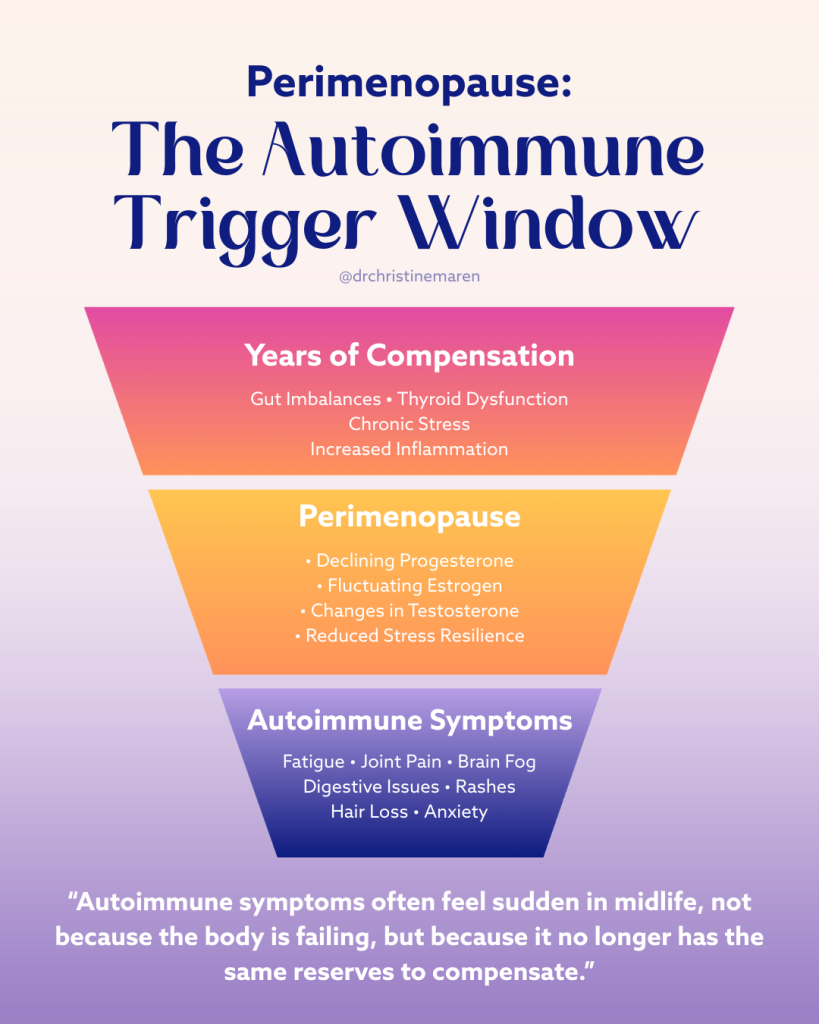
By midlife, many women already carry some immune “baggage,” be it from gut issues, thyroid dysfunction, infections, nutrient deficiencies, environmental toxin exposure, chronic stress and/or years of simply doing too much for too long. Perimenopause shifts the body’s physiology in ways that reduce its ability to buffer stress and inflammation the way it once did.
This is what I refer to as the unmasking effect. Autoimmune symptoms often feel sudden in midlife, not because the body is failing, but because it no longer has the same reserves to compensate.

If this resonates, there's more.
My newsletter and community are where I share clinical insight, evolving research, and what's helping women feel more like themselves again in midlife.
How Hormonal Shifts in Perimenopause Affect Autoimmune Risk
The hormonal shifts of perimenopause have profound effects on the immune system.
Progesterone is typically the first hormone to decline during perimenopause, and the loss is usually felt quickly. Progesterone has well-documented anti-inflammatory and immunomodulatory effects, helping promote immune tolerance and dampen excessive immune activation.3
Changes with estrogen are also destabilizing to the immune system. During perimenopause women may experience chaotic estrogen levels alongside an overall decline. Estrogen supports immune tolerance at certain levels while amplifying immune activation at others, increasing inflammatory signaling and lowering the threshold for autoimmune flares.4,5,6
Testosterone, although all-too-often overlooked in women’s health conversations, also plays an important role in immune regulation. Research shows that women with lower testosterone levels tend to have worse autoimmune disease, while healthy testosterone levels appear to be protective.7
Together, declining progesterone, fluctuating and declining estrogen, and potential reductions in testosterone disrupt immune regulation and inflammatory balance.
But perimenopause goes way beyond hormones, and this is where the gut–immune connection becomes critical.
How Gut Health Impacts Autoimmune Disease During Perimenopause
While perimenopause is often centered around the menstrual cycle, it is far from just a hormone shift—it’s actually a whole-body one. And that includes a shift in the gut microbiome.
Prior to age 40, males and females have very different gut microbiomes, a phenomenon called sexual dimorphism.8 By menopause, however, the female gut microbiome resembles that of a male, a shift associated with reduced microbial diversity, increased vulnerability to gut infections, and impaired gut barrier function.9
Reduced microbial diversity is associated with impaired immune tolerance and increased inflammatory signaling, both of which raise autoimmune risk. We have also known for years that intestinal hyperpermeability, commonly referred to as “leaky gut,” plays a direct role in autoimmune disease development.
Dr. Alessio Fasano’s work established this in the research community when he showed that autoimmune disease requires three things: genetic susceptibility, environmental triggers, and intestinal hyperpermeability (aka “leaky gut”).10
Which is why, in my clinical practice, gut health is always a foundational focus when my patients have autoimmune disease. For a deeper dive, download my free guide: The 6 Habits That Improve Gut Health in Perimenopause
These gut changes bring us to a critical and often overlooked concept in menopause care: the gut–hormone–immune connection, also known as the microgenderome.
The Microgenderome in Midlife: Linking Perimenopause and the Immune System
We now know that perimenopause causes a distinct change in three interconnected systems:
- Hormones
- Gut microbiome
- Immune system
Together, this relationship is known as the microgenderome.
This concept was born in 2013 after a landmark study published in Science showed how the risk of autoimmune disease is shaped by a three-way relationship between sex hormones, gut microbes, and immune signaling.11,12
The microgenderome builds directly on what we know from Dr. Alessio Fasano’s work by helping explain why women are disproportionately affected by autoimmune disease and why symptoms so often intensify during hormonal transitions.
Layered with chronic stress and sleep disruption, this creates a perfect environment for immune dysregulation in midlife.
How to Test for Autoimmune Disease During Perimenopause
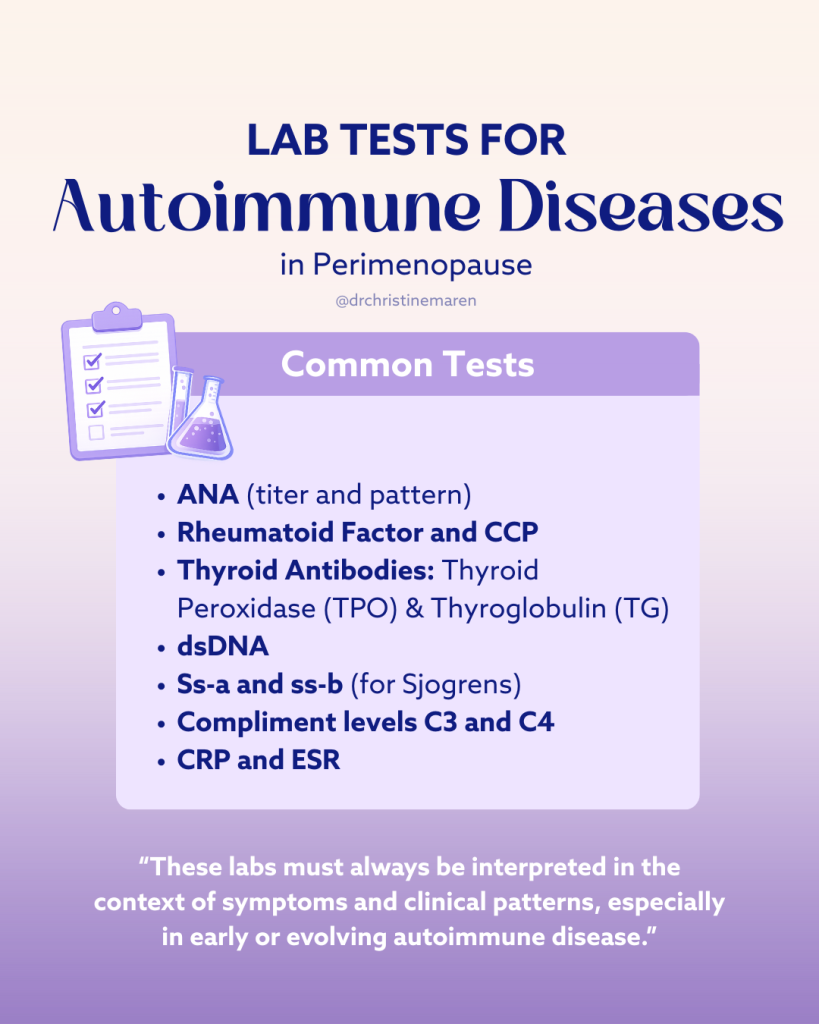
If you’re suspecting an autoimmune disease in midlife, it’s important to ask for additional testing. Sometimes you’ll need to put this on your provider's radar. There isn’t one single lab that identifies all autoimmune diseases, but some of the more common tests I order in my practice include:
- ANA titer and pattern
- Rheumatoid Factor and CCP
- Thyroid antibodies: Thyroid Peroxidase (TPO) and Thyroglobulin (TG)
- dsDNA
- Ss-a and ss-b (for Sjogrens)
- Compliment levels C3 and C4
- CRP and ESR
These labs must always be interpreted in the context of symptoms and clinical patterns, especially in early or evolving autoimmune disease. And for specific symptoms, doctors would order additional testing.
What Treating Autoimmune Disease Looks Like in Perimenopause
When autoimmune symptoms flare up during perimenopause, the instinct is often to look for the thing to fix: the supplement, the diet, the protocol that will make everything calm down again. Some of this can help, but the solution lies in a comprehensive approach that addresses both gut health and hormones.
This is where a functional medicine approach to autoimmune disease becomes especially powerful. Instead of just treating one system in isolation, functional medicine looks at how the gut, hormones, immune system, nutrient status, toxin exposures, and lifestyle factors interact.
What’s often missing from functional medicine care is Menopausal Hormone Therapy (MHT), which is what distinguishes my approach. I’m not only trained in functional medicine, I’m also certified by The Menopause Society. And that goes a long way when we’re treating women in midlife.
Our work focuses on:
- Gut health
- Optimizing hormones
- Correcting nutritional deficiencies
- Supporting better sleep
- Personalized nutrition
- Targeted supplements
- Lifestyle support
Ready to understand the root causes driving your autoimmune disease?
My team and I are deeply experienced in helping women navigate autoimmune disease during midlife, both personally and professionally.
If you’re ready for personalized support, learn more about working one-on-one with my team. We take a root-cause, hormone-informed, whole-body approach, and would be honored to support you.
To stay connected, join my monthly newsletter for insights on hormones, gut health, and autoimmune disease, along with practical tools to help you make confident decisions about your health.
References
- https://pmc.ncbi.nlm.nih.gov/articles/PMC11928423/
- https://pmc.ncbi.nlm.nih.gov/articles/PMC6501433/
- ]https://pmc.ncbi.nlm.nih.gov/articles/PMC3431799/
- https://pubmed.ncbi.nlm.nih.gov/27546235/
- https://onlinelibrary.wiley.com/doi/abs/10.1111/j.1600-0897.1997.tb00275.x?sid=nlm%3Apubmed
- https://pmc.ncbi.nlm.nih.gov/articles/PMC4365931/
- https://pubmed.ncbi.nlm.nih.gov/23328391/
- https://pmc.ncbi.nlm.nih.gov/articles/PMC6517691/
- https://pmc.ncbi.nlm.nih.gov/articles/PMC7098720/
- https://pubmed.ncbi.nlm.nih.gov/22109896/
- https://pmc.ncbi.nlm.nih.gov/articles/PMC4005781/
- https://pubmed.ncbi.nlm.nih.gov/23328391/