

7 Tips + Resources to Cultivate a Healing (Growth) Mindset Right Now
Published On: April 30, 2024

I’ve learned a lot about the nuances of healing in my years as an integrative functional medicine doctor.
One thing that I’ve consistently observed is that patients who are more self-compassionate, use positive self-talk and practice self-care heal faster and maintain better health long-term than patients who push themselves relentlessly, talk down to themselves, and lack self-compassion.
This has taught me that, more often than not, patients struggling with chronic illness (mainly women) don’t need just to take more supplements, be stricter about their nutrition, or exercise more to heal.
They—we all—need to learn how to cultivate a healing mindset rooted in self-compassion.
In my opinion, and that of many doctors and experts, this is the missing link to getting unstuck, overcoming chronic illness, and rediscovering the best version of ourselves.
In this article, we share the same tips and resources on cultivating a healing mindset (aka a growth mindset) that we offer many of our patients in their initial sessions. These include seven tips on how to begin shifting your mindset and a list of our favorite books, articles, and tools to help you break through those unconscious barriers and rediscover your best health.
What Is a Healing Mindset (aka a Growth Mindset)?
If you’re reading this article, you’ve already taken a significant step toward overcoming whatever health issues are holding you back.
As a mother of three who has overcome her share of complex health issues and helped hundreds of people do the same, I applaud your courage and resourcefulness in getting to this point.
However, as mentioned above, committing to making physical and lifestyle changes required to address the root cause is only one slice of the gluten-free pie.
You’ll also need to work on cultivating a healing mindset, also known as a growth mindset.
What is a Growth/Healing Mindset?
A growth or healing mindset is the belief that a person can change, transform (or heal), and grow over time.
In contrast, a fixed mindset is the belief that a person cannot change, transform (heal), or grow over time.
You cultivate a healing mindset by gaining awareness of any messaging in your subconscious about your health and self and changing the story of self-doubt to self-belief.
In essence, you can believe in your ability to improve how you feel.
Again, the very fact that you’re reading this article shows that deep down, you know you deserve (and therefore can achieve) better health.
This is a fantastic start because it shows you believe in yourself and know that you deserve health and happiness on some level.
Growing that healing mindset simply requires developing more self-awareness about what we think and believe about ourselves and our circumstances.
The best way to get started with this is to identify any limiting beliefs.

If this resonates, there's more.
My newsletter and community are where I share clinical insight, evolving research, and what's helping women feel more like themselves again in midlife.
9 Questions To Help Identify Limiting Beliefs
You can’t change a body you hate. Read that again because this is the biggest limiting belief that holds people back.
To identify this and other hidden limiting beliefs, ask yourself the following questions:
- How do you honestly feel about your body and your health right now?
- What stories are you telling yourself about your health or how you got to this point in your life?
- Who do you blame?
- Do you have self-criticism or -ridicule?
- Do you feel frustration and pessimism?
- Do you feel fear and judgment?
Now, can you get curious (instead of judgemental) about these stories and ask yourself if they are true stories?
- Do these stories serve and motivate you? Or do they keep you stuck?
- Are you open to the belief that things can improve?
- Can you picture your health better than it is now?
In our practice, we help guide patients through these types of questions so they can become open to the belief that they can heal.
The information and tips coming up will help guide you as well!

7 Tips To Help You Cultivate A Healing Mindset
Now that you have a basic understanding of mindset, let’s look at seven tips to help cultivate a healing mindset and lay the foundation for transformative healing.
Tip 1: Accept Where You Are Right Now…And Believe Change Is Possible
This may sound cliche, but we cannot change what we do not acknowledge and what we cannot accept.
Accepting yourself and your state of health honestly, in all its imperfection, without excuses or shame, exactly how it is right now, is essential to kick-starting the healing process. But don’t stop there!
You must also allow yourself to believe that change is possible.
If you don’t believe that, consider that the only constant in life is change.
This is true of your body, too—no matter how long it’s felt sick, fatigued, or just stuck.
Your body is constantly adapting to its environment, including the food we eat or don’t eat, the sleep we get or don’t get, the toxins we are or aren’t exposed to, the way we move or don’t move, our perception and reaction to stress, and our continuous thoughts all day long.
All this changes our expression of health or disease, right down to our gene expression and immune function.
I explain this more in my article: What I Wish I’d Known About Stress and Autoimmune Disease.
So, if we can accept where we are now and begin taking steps to change these things (emphasis on stress response and thoughts), that means our bodies can change too.
“You cannot shame yourself into change. You can only love yourself into healing.” - Dr. Caroline Leaf
Tip 2: Journal About Why You Want To Heal
Journaling is a potent tool for enhancing self-awareness, reducing stress, and shifting your mindset.
There’s even a type of journaling called “health journaling,” which involves not only tracking your healing progress but also writing down why you want to heal in the first place.
The questions on self-limiting beliefs above are all excellent topics to start journaling about.
Here are some additional prompts to help you get started:
- What is motivating you to heal? Find your WHY - this is important!
- Do you believe you can heal? (yep, there’s that question again!)
- What are you willing to do or change to regain your health and happiness?
- What (if anything) is holding you back from committing to healing right now?
- What would you be able to do once you’ve healed that you can’t do now?
- What parts of your life would you change if you felt like yourself again?
This practice may seem simple, but it serves multiple purposes in cultivating a growth/healing mindset, including providing motivation and enhancing self-introspective, self-compassion, self-awareness, and mindfulness.
Research has also shown journaling can improve sleep,1,2 reduce blood pressure, improve immune function,3 improve mindfulness, and promote various aspects of mental health.4
Tip 3: Understand Your Thoughts Are Separate From Who You Are
Most of us don’t realize that our thoughts are separate from who we are because they are with us all the time.
Yet, if you have a thought and can “hear” the thought, then by definition, it must be something separate from you, the listener, to be able to hear and observe it.
Imagine yourself as a large, strong, solid boulder in a mountain river stream. Your thoughts are like the river water passing over and around you—not part of you but capable of shaping you.
Now imagine looking down from a bridge above, watching all of your “thoughts” pass by, and noticing how none of them stick—they just move along.
This perspective, which can be a meditation practice, helps us separate ourselves from our thoughts so we can better observe, be curious about, and ultimately choose which thoughts better serve us.
You will never hear a person’s voice more than you hear your own; be intentional about the way you talk to yourself.
Tip 4: Enhance Awareness About Your Thoughts Through Meditation or Mindfulness
Enhancing awareness of our thoughts is essential because they directly and acutely shape our body’s environment.
For example, research has shown our brains create chemicals in response to “sticky thoughts” (the type we can’t let go of or that go around and around in our brain) that are released into our blood and touch and affect each and every cell.5
Our thoughts literally become our biology.
We think all day long, often in ways we aren’t even aware of. So, it’s vital to practice increased awareness of our thoughts so we can better understand them and ultimately have more influence on how they impact us.
Mindfulness practices such as meditation, silent walking, saying mantras and prayers, practicing Qi Gong, Tai Chi, or Yoga, spending time in nature, and keeping a gratitude journal are excellent ways to practice witnessing our thoughts like a river flowing over a boulder.
We’ll share some of our favorite meditation tools in the resources section.
Tip 5: Practice Self-Care And Self-Compassion
Self-care is a trendy term that’s been used so much that it’s become a bit superficial and almost lost its meaning, which is rooted in self-compassion.
The true purpose of self-care is to take some time every day—not just on the weekends or once a year—to appreciate and take care of yourself, body, mind, and spirit.
When we look at it from this perspective, it becomes less about making grand, expensive, time-consuming self-care plans and more about making self-care/self-compassion a part of your health routine and everything in life.
Some simple ways to do this include more self-compassion in your life include:
- Reading or listening to audiobooks about cultivating self-compassion (we have some recommendations coming up)
- Feeding yourself nourishing, protein-rich meals (including breakfast!) three times a day
- Getting regular movement
- Spending time with friends and community
- Getting sunlight and time outdoors
- Taking time out for a hobby
- Speak to yourself kindly, the way you would your child or a best friend. For example, instead of saying, “I hate that about myself” reframe that to “I see this as an opportunity for growth.” It takes a little practice, but focus on reframing seemingly negative self-talk in a more positive light.
Trends in elaborate self-care rituals (which have their place) may make us think these things don’t count, but the daily habits we adopt make the most difference in how we perceive and treat ourselves on the path to a growth mindset.
“Love yourself first, and everything else fits. You really have to love yourself to do something in this world. “
- Lucille Ball
Tip 6: Let Go Of Perfection—Even In Healing
Perfection is the enemy of progress…or even getting started sometimes.
When we’re in a fixed mindset, we often feel we can’t commit to change or healing unless we can go in 100%.
But being “all in” for your health and happiness isn’t the same as feeling you have to do everything perfectly.
As I always tell my patients, you can’t live in a bubble.
In fact, it would be terrible for your emotional well-being! As Dr. Gundry famously says, “Do the most you can with what you got as often as possible.”
Regarding a healing mindset, we’d invite you to let go of trying to be perfect 100% of the time and instead follow the 80/20 principle.
80% of the time, do what you can to move the needle closer to healthier living for you; 20% of the time, live your life without fear or apology.
Your heart and soul will thank you for it, and that does a body good, too.
“When perfectionism is driving us, shame is riding shotgun, and fear is that annoying backseat driver!” -Brené Brown
If this resonates, there's more.
My newsletter and community are where I share clinical insight, evolving research, and what's helping women feel more like themselves again in midlife.
Tip 7: Give Up Comparisons
I know this is easier said than done, but most of us waste a tremendous amount of energy comparing our bodies, state of health, weight, lifestyle, etc., to others.
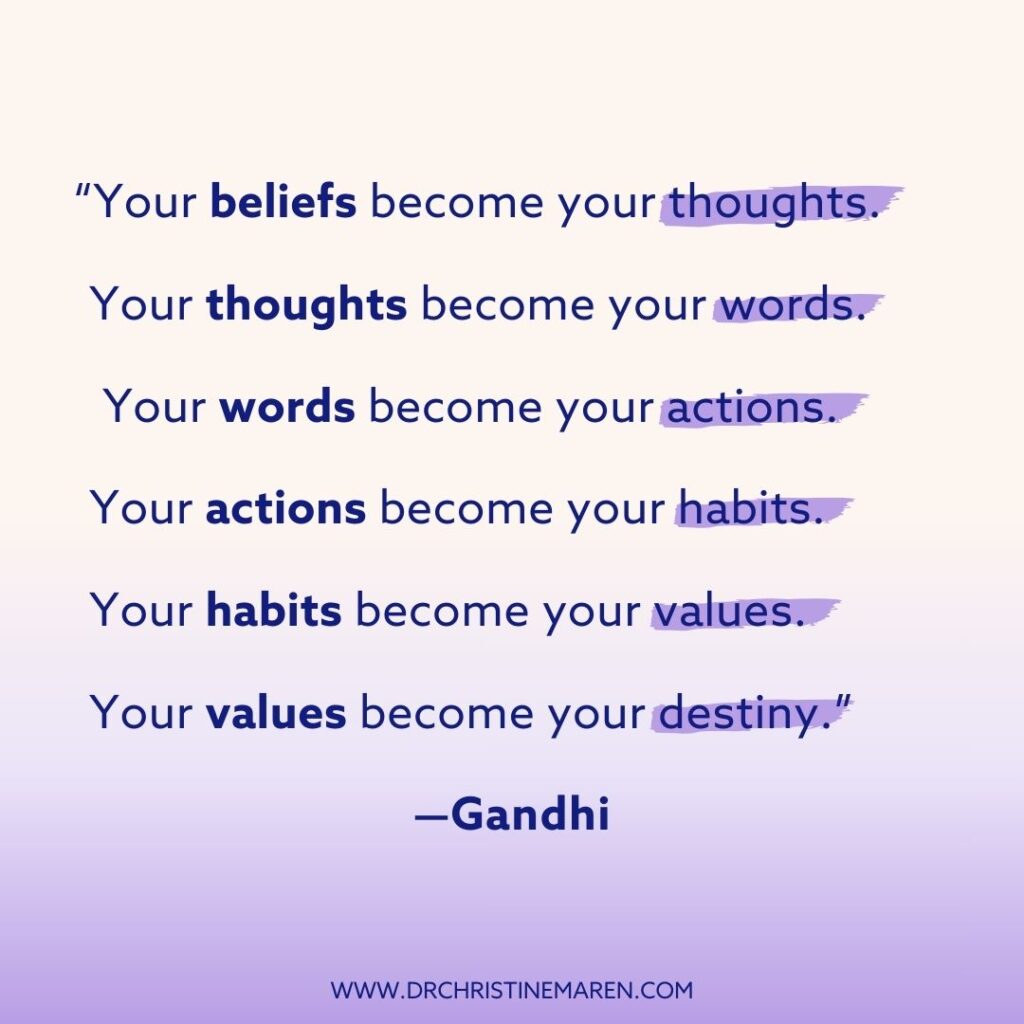
Comparisons, which manifest as thoughts, which manifest into beliefs, etc., are the enemy of a healing mindset because they keep us stuck in a state of self-judgment.
The good news is that the same rules for edging out unhealthy foods by loading up our plates with healthy foods (clean protein, colorful veggies, clean carbs) apply to breaking the comparison habit.
By taking steps to cultivate greater self-compassion (e.g., building self-awareness through mindfulness, giving up perfection, practicing self-care, practicing gratitude), we will automatically make less space in our minds for comparisons.
Plus, cultivating more thought awareness will help us quickly catch and divert those comparison thoughts when they come up instead of going on autopilot.
Isn’t it amazing how far a little mindfulness and self-compassion can go? It truly is one of the biggest and underappreciated game-changers in healing.
“Comparison steals joy, focus on your beautiful path.” - Helen Marie, Integrative Therapist
Resources To Support Cultivating A Healing/Growth Mindset
Switching your mindset can be a process, especially if there is childhood trauma (which could be anything from abuse or neglect to a lack of attachment in infancy and childhood, loss, or divorce).
Does that mean you should wait to begin your healing process until you undo all your childhood trauma and get fully into the right mindset?
Heck no! In fact, switching your mindset and getting to the root cause of the behaviors and habits you don’t like is all a part of a holistic, root-cause healing process.
I now firmly believe you cannot heal the body without healing the mind and spirit.
So, where do you start?
In addition to implementing the tips above, we recommend the following resources to our patients.
These are books, apps, and tools my team and I have relied on/do rely on to cultivate and nurture our healing/growth mindsets, and they have been absolutely life-changing.
Books to Cultivate a Healing Mindset
- Self-Compassion: The Proven Power of Being Nice to Yourself Kristin Neff, Ph.D
- The Myth of Normal: Trauma, Illness & Healing in a Toxic Culture by Gabor Mate, M.D.
- The Untethered Soul: The Journey Beyond Yourself by Michael A. Singer
- Man’s Search for Meaning by Dr. Viktor Frankl
- The Biology of Belief by Bruce Lipton
- Gut Feelings: Healing the Shame-Fueled Relationship Between What You Eat and How You Feel by Dr. Will Cole
- Atomic Habits: An Easy & Proven Way to Build Good Habits & Break Bad Ones by James Clear
- The Power of Now Eckhart Tolle
Articles from Yours Truly
- What I Wish I’d Known About Stress and Autoimmune Disease
- Why HPA Axis Dysfunction May Be More Important Than Gut Health
- 12 Functional Nutrition Principles To Help You Ditch Dieting & Get Healthy for Life
Meditation/Mindfulness Apps and Music
- Ziva Meditation
- Sarah Blondin’s meditations, available on Spotify
- Joe Dispenza’s meditations can be downloaded from his website
- Gabby Bernstein’s meditations and coaching app
- Muse Meditation Headband acts like a personal meditation coach, helping detect when your mind wanders and giving you gentle audio cues to bring your focus back to the present (use code MAREN for 15% off)
- Sensate is a sensory device that that uses vibrations and sound to lower stress
- Headspace
- Calm
- Insight Timer
- Othership for guided breathwork
- Mantras in Love by Beautiful Chorus, available on Spotify
Tools for Self-Care and Mindfulness
- Oura ring is great for tracking quantity and sleep quality (P.S. Try this link and you might get $50 off).
- HeartMath Heart Rate Variability (HRV) training. HRV training is a form of biofeedback that works by activating and calming our autonomic nervous system. This comes in handy for tracking your stress response via your nervous system.
- Higher Dose PEMF Mat (use the code, DRMAREN75 for discount). This amazing little mat grounds you to the earth’s magnetic field (aka: “earthing” or “grounding”) while using infrared heat to enhance the relaxation experience. This helps me get back to sleep during those restless (or child-interrupted) nights.
- Red Light Therapy is part of my morning routine and easy to fit in during meditation, journaling etc. It’s great for skin (from acne to rashes to wrinkles), mitochondria, workout recovery and even thyroid health.
Looking For A Functional Medicine Team Who Values Mindset? We’d Love To Meet You!
We are passionate about helping patients get to the root cause of their health concerns.
One thing that sets us apart from other functional medicine practices is that we value mindset as much as our other healing tools.
We don’t just preach about it. We all (myself and the other women on my team) are deeply committed to cultivating our own healing mindsets and helping our patients do the same.
If you’re in my tri-state area (Colorado, Michigan, or Texas) and are looking for a provider who understands functional medicine and mindset, my team and I would love to hear from you.
For everyone else, I’d love to stay connected Via Instagram or through our Monthly Newsletter.
- https://pubmed.ncbi.nlm.nih.gov/25736389/ reduce stress and anxiety
- https://www.ncbi.nlm.nih.gov/pmc/articles/PMC6305886/
- https://www.cambridge.org/core/journals/advances-in-psychiatric-treatment/article/emotional-and-physical-health-benefits-of-expressive-writing/ED2976A61F5DE56B46F07A1CE9EA9F9F/core-reader#
- https://pubmed.ncbi.nlm.nih.gov/35304431/
- https://www.ncbi.nlm.nih.gov/pmc/articles/PMC7725397/